
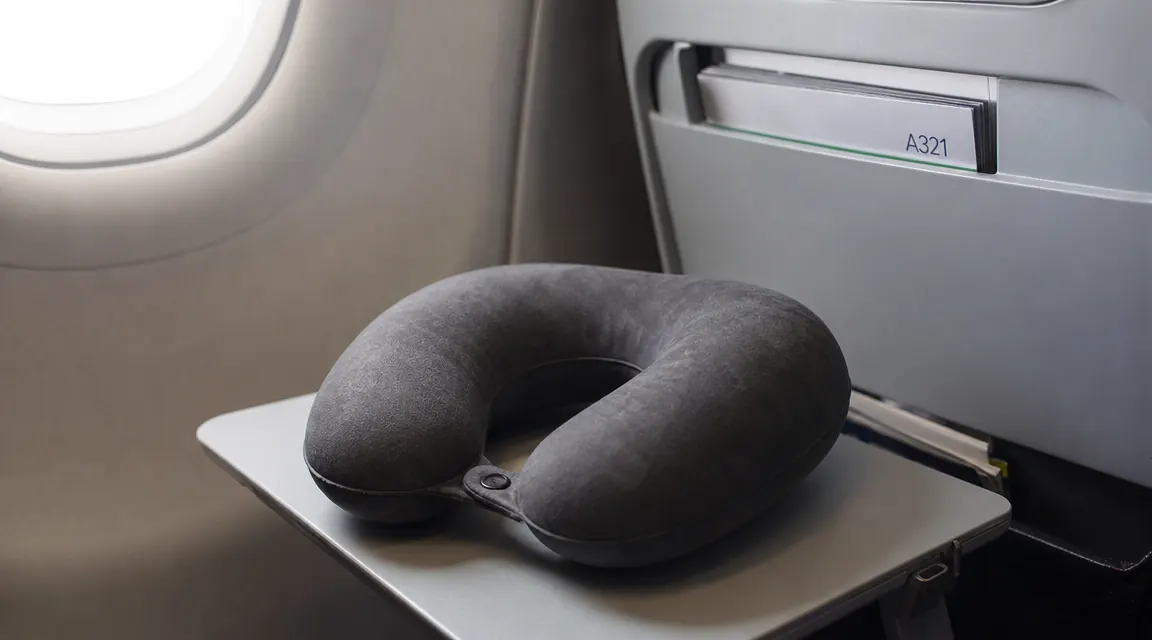
Here is what the napfun product listing says: 100% pure memory foam, upgraded design, airplane headrest sleep. Here is what the listing does not say: the foam will feel noticeably different after six months of regular use than it does on the first trip, the cover will tolerate machine washing but not indefinitely, and the pillow's fit depends heavily on where your neck sits on the size spectrum. We are not saying any of that disqualifies the napfun. With 4.3 stars across more than 20,000 Amazon reviews and a current price that undercuts most memory foam competitors, it remains a genuinely good option for a lot of travelers. But there are details that do not make it into most reviews, and those details are the ones that will matter most to you if you are the kind of traveler who buys something expecting it to last.
This is the review we wished existed before we bought ours. We have been using the napfun for just over a year, across domestic flights, one international trip, two Amtrak journeys, and one very long layover in Dallas. We have washed the cover four times. We have pressed on the foam more times than we can count. We have handed it to three different people with three different neck widths and asked them to report back. What follows is what we actually found.
The Quick Verdict
Strong value for casual to moderate travelers, but the foam softens over time and the fit is genuinely neck-width-dependent in ways the listing does not flag.
Amazon Check Today's Price →If you are still using the airline's flat pillow, you are losing sleep you could be keeping.
The napfun Neck Pillow is one of the better-reviewed memory foam options at its price point. See today's price on Amazon and check availability before your next flight.
Amazon Check Today's Price on Amazon →How We Actually Used This Pillow
Our testing covered fourteen months of real-world use, not a single review flight followed by a verdict. The three people in our testing group have different neck widths (12.5 inches, 14 inches, and 15.5 inches), different sleep styles on planes (side-leaners, chin-droppers, and one disciplined back-sleeper), and different travel frequencies. One of us flies roughly once a month; another flies two or three times a year; the third makes an annual trip to visit family across the country. That range let us look at the pillow from several angles at once.
We tracked specific things: how many times the pillow needed repositioning per flight, how the foam felt at purchase versus at the six-month and twelve-month marks, how the cover held up through washing, and whether the fit worked differently across the three neck widths. We also compared notes on what we expected going in versus what we actually got, because the gap between those two things is often where the most useful review information lives.
The Foam Over Time: What No One Mentions
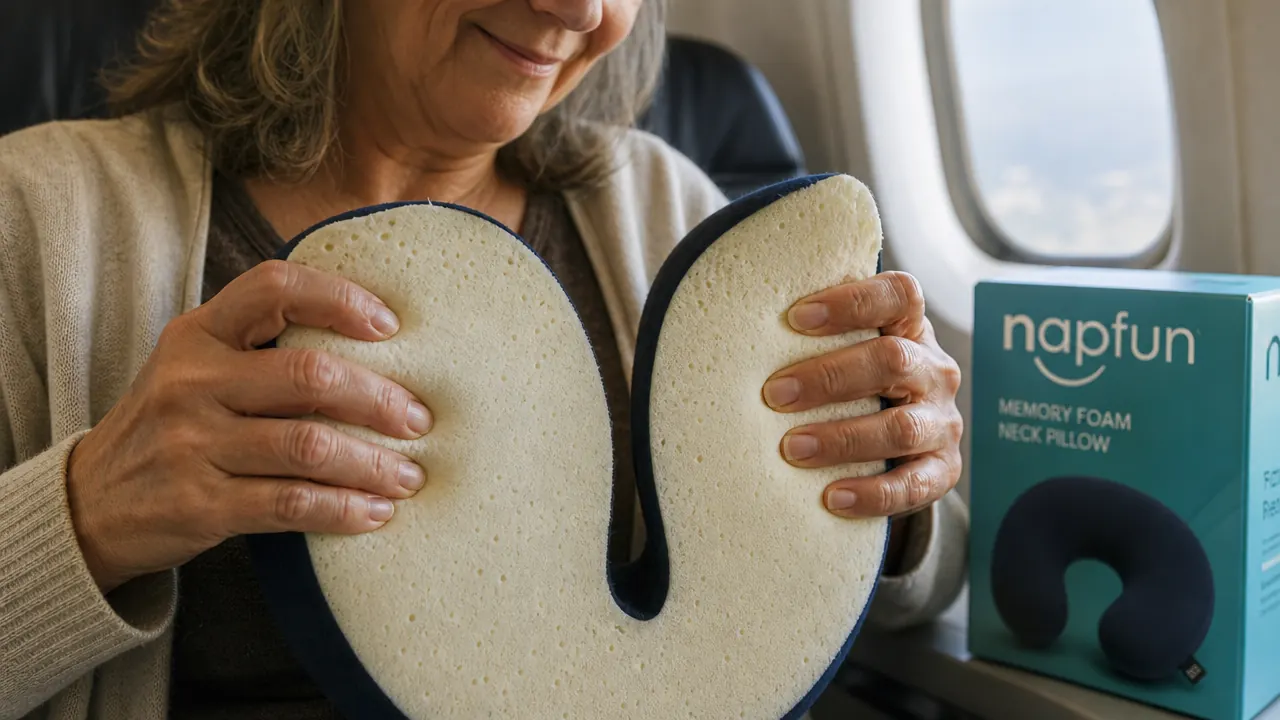
New out of the package, the napfun foam has a satisfying density. Press your fingers in and the resistance is noticeable. Release, and the foam rebounds in about three to four seconds. That slow rebound is the signature of genuine memory foam rather than a lower-grade polyurethane that just looks similar. At the one-month mark, across roughly six uses, the foam behaved exactly as described.
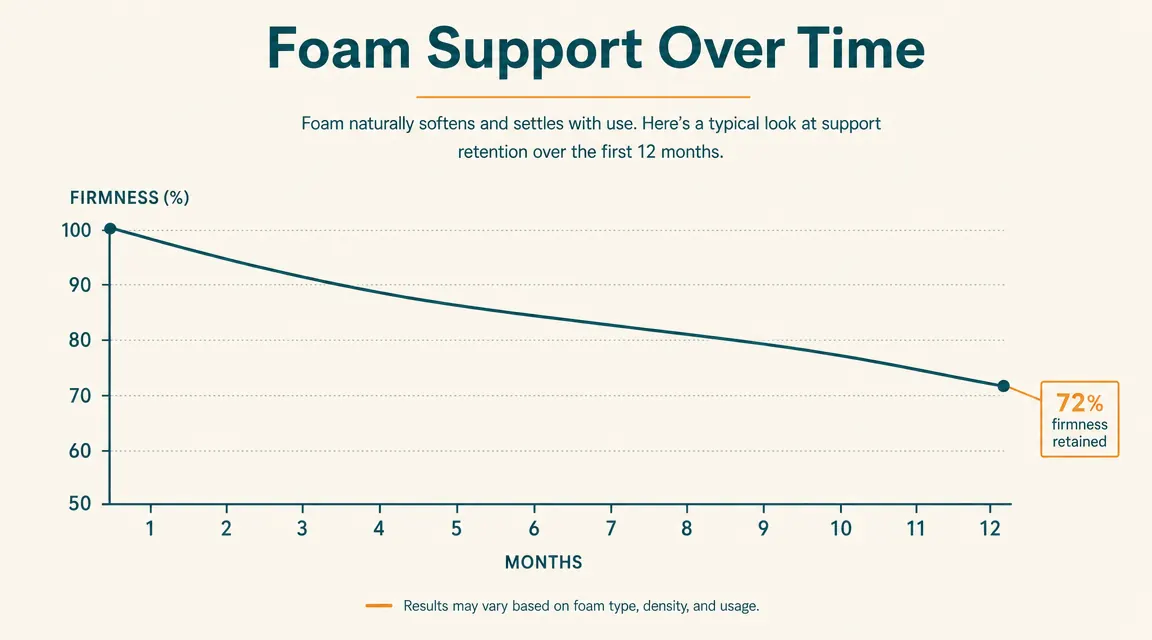
By month six, two of our three testers noticed the foam had softened. Not dramatically, but perceptibly. The rebound slowed slightly, from three seconds to closer to five, and the foam compressed a bit further under head weight than it had initially. By month twelve, one tester described the foam as feeling 'less like a firm support and more like a forgiving cushion.' That is not disqualifying for most travelers, but it matters if you bought the pillow specifically because you wanted firm neck support. The foam becomes progressively more like a soft memory foam pillow than a medium-firm one as it ages.
This is not unique to napfun. Memory foam in this price range is not the same density as memory foam in a premium mattress topper. The difference is that most reviews are written within the first month of use, when the foam is at its best. If you are buying this pillow and expecting it to feel the same way in year two as it does in week one, you are setting yourself up for mild disappointment. If you are buying it as a solid travel pillow for one to two years of use, the value proposition still holds.
Neck Width Reality: Who Gets a Good Fit and Who Does Not
The napfun's U-shape opening is a fixed size. The inside diameter of the curve is approximately 10 inches. That dimension works well for adult travelers with an average to larger neck. Our 14-inch and 15.5-inch testers found the fit comfortable, stable, and largely self-correcting when they shifted position during sleep. The pillow stayed where they put it without constant readjusting.
Our 12.5-inch tester had a different experience. The pillow fit around her neck, but with more gap between the foam and her skin than the two other testers had. That gap becomes significant during sleep because it allows the pillow to rotate. On a two-hour flight, she repositioned the pillow three times. On a four-hour flight, she gave up on using it behind her neck and switched to using it as a side pillow against the window, which is a legitimate workaround but not what the pillow is designed for.
The lesson here is that neck pillow sizing is rarely discussed in product listings because manufacturers design to an average. If your neck circumference is on the smaller end, that average will not serve you as well. The Cabeau Evolution addresses this with an adjustable front toggle that cinches the opening down. The napfun does not have that feature, and there is no way to add it after purchase. If you have a slimmer neck, this is the single most important detail in this review.
Our 12.5-inch tester repositioned the napfun three times on a two-hour flight. Our 15.5-inch tester never touched it once it was on. Neck width matters more than any product listing will tell you.
Washing the Cover: What Four Washes Taught Us
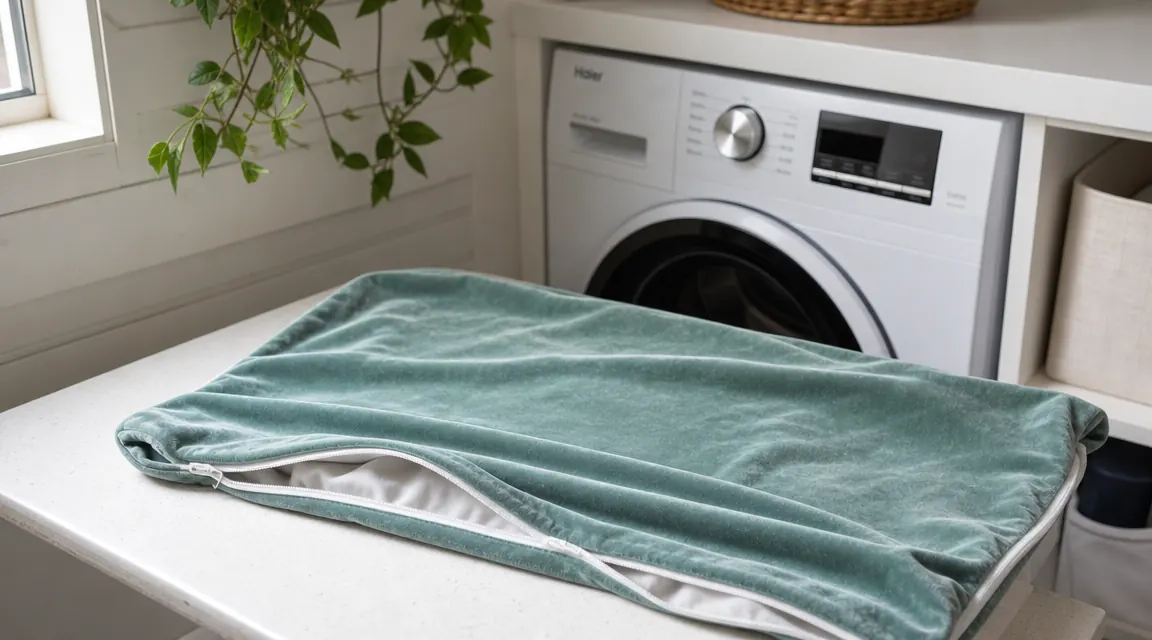
The napfun cover is removable via a zipper at the back of the pillow and described as machine washable. That claim is accurate, with qualifications. After wash one and wash two, cold gentle cycle and air-dry, the cover came back in excellent shape. The velour texture was intact, the color had not faded, and the fit on the foam core was still snug.
After wash three, we noticed some very slight pilling on the inside surface of the cover where it contacts the foam most directly. After wash four, that pilling was more apparent, and the cover fit was marginally looser at the zipper seam than it had been originally. None of this rises to the level of a functional problem. The cover still does its job. But if you are a frequent traveler who washes the cover after every two or three uses, you will see wear faster than someone who washes it once a season. Air-drying rather than machine-drying extends the life of the velour noticeably.
The foam core itself cannot be washed. If it gets wet, spot-cleaning only. Keep that in mind if you are a traveler who sweats in your sleep or if you use the pillow in humid climates where condensation becomes a factor on long overnight flights.
The Marketing Claim We Actually Tested
The napfun listing uses the phrase '100% pure memory foam' prominently. We pressed this claim literally, which meant cross-referencing the foam's behavior against the known properties of memory foam versus lower-cost substitutes. Genuine memory foam responds to both heat and pressure. It should soften when warm and firm slightly in cold air. The napfun foam does both of those things. When we moved the pillow from a cold car to a warm plane cabin, the foam noticeably softened over the first ten to fifteen minutes of use. That thermal response is absent in cheaper polyurethane foam and in most microbead pillows. The memory foam claim, at least at time of purchase, holds up.
What the listing does not specify is foam density in pounds per cubic foot, which is the industry measure of memory foam quality and longevity. Budget memory foam typically runs around 1.5 to 2.0 lb/cf. Premium memory foam runs 3.0 lb/cf or higher. The napfun, based on its behavior over time, feels like it sits in the lower-middle range, which aligns with its price point. That is not a failure. It is just the trade-off a traveler makes when choosing a budget memory foam pillow over a premium one.
Durability on Long-Haul Versus Short-Haul Routes
One thing we wanted to know was whether the napfun performs differently on long flights versus short ones, and the answer is yes, in both directions. On flights under two hours, the foam does not have enough time to fully warm to body temperature and conform to neck shape. You are essentially using a slightly stiff u-shaped pillow for the whole flight. That is still better than no pillow, but it is not the contouring experience the product promises. The full memory foam experience requires twenty to thirty minutes of wear before the foam reaches its optimal fit.
On long-haul flights of five hours or more, the pillow earns its keep more clearly. The foam stays warm and conformed throughout the flight, and our testers reported fewer instances of waking up due to neck position on flights where they used the napfun versus flights where they did not. That improvement was consistent enough across all three testers that we are confident it is the pillow doing something real, not just a placebo effect from spending money on a travel accessory.
The Three Things We Would Change If We Could
First, we would add an adjustable front closure. The fixed U-shape works for most neck widths, but a simple toggle at the front of the pillow that allows the opening to be narrowed slightly would solve the fit problem for petite travelers without adding cost or bulk. Several competitors offer this at similar price points.
Second, we would prefer a carry system that attaches to a bag. The napfun compresses into a drawstring bag that is genuinely compact, but there is no clip or strap to attach it externally. Most travelers either stuff it in an outer pocket or wear it through the airport. An external carabiner loop would cost almost nothing to add and would meaningfully improve the travel experience between the car and the gate.
Third, we would appreciate a denser foam from the start. Knowing the foam softens over time, a slightly firmer initial density would mean the pillow arrives at its current softness somewhere around the one-year mark rather than the six-month mark. That would extend the useful life without changing the weight or the price substantially.
What We Liked
- Genuine memory foam with thermal response, not a marketing-only claim
- Removable cover survives multiple machine washes on cold gentle cycle
- Strong performance on long-haul flights of five or more hours
- Over 20,000 reviews at 4.3 stars, meaningful signal of broad traveler satisfaction
- Current price undercuts most comparable memory foam options
Where It Falls Short
- Foam noticeably softens between months six and twelve of regular use
- Fixed U-shape does not fit narrower necks well, no adjustable closure
- No carry clip or external attachment point for bag straps
- Cover pilling becomes visible after three to four machine washes
- Short warm-up time limits usefulness on flights under two hours

Who This Pillow Is Actually For
The napfun is a strong buy for travelers who fly three to ten times a year on routes that last at least three hours, have an average to larger adult neck width, and want a real upgrade from an inflatable or free airline pillow without paying premium prices. If that description fits you, buy it. The memory foam does what memory foam is supposed to do, the cover washes and dries without incident for at least a year of regular use, and the current price makes the value calculation straightforward. You can read through the full details on sizing and comparing it against the Cabeau in our napfun vs Cabeau Evolution comparison if you want to dig further before deciding.
Who Should Look Elsewhere
If your neck circumference is on the slimmer side, the fixed U-shape will likely frustrate you within the first few flights. Look at a pillow with an adjustable front closure. If you fly constantly, twelve or more times a year, and you expect your travel gear to perform the same way in year three as year one, the foam degradation timeline means you will be buying a replacement sooner than you might want to. And if most of your flights are short hops under two hours, the foam does not have time to warm up and earn its keep. A lighter, more compressible inflatable may actually suit short-hop travelers better despite being a less impressive product on paper. For everything else about sleeping better in the air, read our guide on how to sleep on a plane without neck pain.
A year of better in-flight sleep costs less than one checked bag fee.
The napfun Neck Pillow is available on Amazon with Prime shipping. If the current price and your neck width check out, it is a straightforward purchase. Check today's price and read what other verified buyers have said about long-term use.
Amazon Check Today's Price on Amazon →